The Ultimate Guide to DRS in F1: How It Works and Its Impact?

Key Takeaways
- DRS decreases the drag effect through the opening of a flap on the rear wing, thereby aiding drivers in achieving speed on straightaways and enhancing their chances of overtaking.
- On the whole, DRS technology can be deployed during a race if a driver trails behind another car by no more than a second.
- Even as DRS technology has enhanced excitement in wheel-to-wheel racing, it continues to remain controversial for many fans, considering it makes overtaking too predictable.
The Drag Reduction System (DRS) is a hot topic in Formula 1. It's a tool drivers use to help with overtaking and to get some more wheel-to-wheel action. The driver hits a button to open a flap in the rear wing, cutting down on drag and boosting speed when they're within a second of the car ahead. This system has been around since 2011 and is still in play with the new rules coming in a few years ago. But, just like when it first came out, DRS is still a big talking point for racers and fans.
The Functioning of DRS
There's an actuator that moves a flap in the middle of the car's rear wing. The F1 driver has the ability to press the button in order to activate the system, but that can happen in special sectors of the track referred to as the DRS activation zones. The opening of the flap reduces the wing surface area, which increases speed on straightaways.
DRS can only be used if a car is within a second of the one in front. During qualifying, it can be used anytime. F1's timing tech checks the gaps between cars at specific points before the DRS zones, called detection points. If a car is less than a second behind, a signal tells the driver they can use DRS in the zone. Once activated, it stays on until the driver either lifts off the gas or hits the brakes.
Drivers don't have to use DRS even if they're within a second of another car. It's their call. Also, DRS can't be used during the first two laps of the race or after the rolling starts, like in safety car situations. If a driver is less than a second ahead of another car, they can use DRS too, as long as they are within a second of the car in front of them. Critics say modern drivers rely too much on tech like DRS instead of sharpening their attacking and defending skills.
DRS Zones Present on the Track
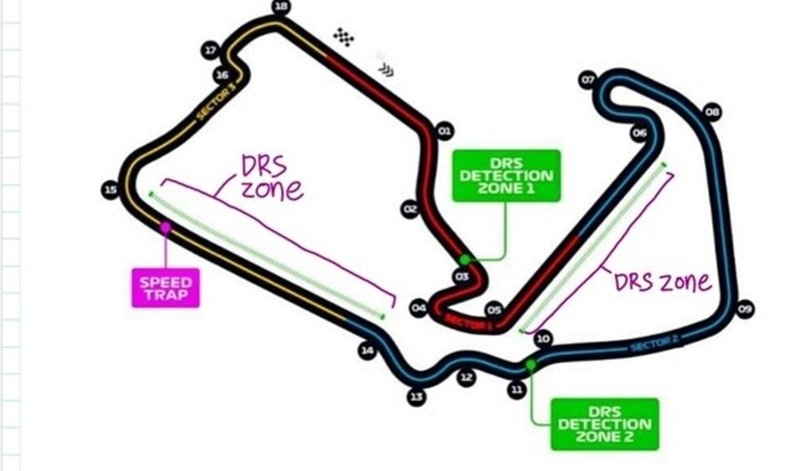
How many DRS zones are on a track really depends on the location. There's no set number. Basically, every main straight on a track will have a DRS zone. If a circuit is known for few overtakes, more zones can be added. While DRS can be used on corners with shallow angles, where the curves aren't even considered turns by the FIA, it's usually not smart to have the wing slot open during these times.
Not every DRS zone opportunity is taken by drivers. At these points in a race, the reduced drag from the DRS would increase the car's top speed, but the reduced downforce would mess with the driver's control of the car. This can lead to crashes, so DRS zones usually end at the end of a long straight. DRS has its technical issues too. A system failure can leave the rear wings stuck open. When this happens, drivers get shown the black flag with an orange disc.
At this point, drivers have to go back to the pit lane, where their team can close the flap manually. It can't be used again if not fixed properly. Drivers can only use their DRS in the pre-set activation zones and when they're within one second of the car in front. So, the system shouldn't be overestimated in terms of its impact on the sport, but for now, it's still a big part of Formula 1.
You May Also Like: Unraveling the Mystery of DNF in Formula 1 Racing Here
Reasons for the Introduction of DRS
Well, DRS, or Drag Reduction System, was mainly introduced to make overtaking easier. Some folks were pretty excited about it because F1 races were getting kind of dull, with overtaking becoming rare. But DRS has its critics too. Just pressing a button to overtake doesn't exactly showcase driver skill or make one constructor stand out from another.
Remember how Michael Schumacher used to take unique lines to set up his overtakes? He was a genius at it. Now, with DRS, he would've just hit a button and likely passed at specific points. But it's not that simple. Drivers still need to get close to the car ahead on their own, and DRS just helps them overtake when they'd usually be stuck in the dirty air behind a slower car.
With recent advancements, the dirty air effect isn't as bad, so DRS might be phased out someday, but for now, it's still around.
F1 isn't just about engine power; aerodynamics and airflow are huge too. Teams have to manage these aspects, and DRS is part of that. The dirty air problem was really bad in the late '90s and early 2000s.
Back then, some teams would use strategies like letting a car further back in the pack take over once a rival at the front stopped. Fans hated it, so something had to change. DRS came in 2011 and has been used during the turbo hybrid era. In 2022, F1 went back to ground effect rules because of dirty air. Engine and fuel rules will change again in 2026, and until then, DRS will still be important.
DRS Usage Frequency and Speed Boost
F1 drivers may use the DRS only in certain zones of the track if they are no more than one second behind the vehicle in front of them. The exact number of times it can be used depends on the rules of a particular race.
In general, it depends on the organizers of the race and the FIA. In terms of mechanics, it involves creating a hole of up to 85 millimeters that leads to reduced downforce. As a result, drivers can increase their top speed by 15 kilometers per hour. The precise value will depend on many factors, including the length of the straight, wind speed, etc. The usage of DRS in F1 is quite controversial.
There are concerns that it facilitates overtaking and diminishes drivers' skills and tactics. There are also worries related to safety since it may lead to a higher accident rate.
Similar Reads You May Enjoy: Unveiling Significance of Pole Position in Formula 1 Racing
Conclusion
The Drag Reduction System (DRS) has been revolutionary in transforming the Formula 1 racing game since its introduction in 2011. The DRS has greatly influenced the outcomes of races due to overtaking, and the fans have something to cheer for in the future.
This system makes it possible for cars to reduce drag and be faster on straights, thus overcoming some of the challenges associated with turbulent air and dirty air that previously made close racing difficult.
However, DRS is not without its controversies and complexities. Critics argue that it sometimes creates artificial overtaking, diminishing the value of pure driver skill and car performance. The system's rules and activation zones are continually tweaked to balance these concerns, ensuring that DRS enhances the racing spectacle without overshadowing the essence of the sport.
Frequently Asked Questions
In what year was DRS implemented in Formula 1?
The implementation of DRS took place in 2011 with the aim of making overtaking more straightforward in Formula 1. DRS was created to reduce the impact of aerodynamic interference, as well as dirty air that would make it hard for a driver behind to get close enough to initiate an overtake.
Do F1 drivers have access to DRS whenever they like?
No, in the course of the race, DRS may be used by F1 drivers only on specific circuits and when the requisite gap to the driver in front has been achieved by the detection point. Race control can limit the use of DRS based on different considerations.
Can DRS make an F1 car faster?
Using DRS will allow the car to accelerate on the straights since it reduces the aerodynamic drag. However, the amount of increase depends on variables such as the circuit, the configuration of the rear wing, the weather, and the duration of the straight. The use of the DRS also results in a loss of downforce.
Why do some F1 fans hate DRS?
The reason why there is a group of F1 fans who hate DRS is due to the fact that DRS can make overtaking too easy or predictable since the car behind is granted the aerodynamic advantage on certain sections of the racetrack.
Is there the use of DRS in qualifying sessions?
There is the use of DRS in qualifying sessions as per the rules that apply in the period under discussion. Drivers are allowed to make use of DRS without the one-second rule in a race if they are within the DRS activation zones.
This content was created by AI